Accessibility, the journey AND the destination
What does it take to make something accessible to everyone? Join me on both the journey and the destination of accessibility, with tips for what you might need for the adventures ahead.
Last January, we shared about how excited we were for the year ahead. And, wow, it was quite the ride. No one told us that 2014 would be quite as exhilarating or as challenging as it was. Yet, no matter which part of the wave we were on, high or low, we never lost sight of our vision and our mission. Today, we still believe that the power of digital belongs to everyone, and that includes people with disabilities. That fundamental belief drives all of our actions every single day. And, it helps us fulfill our mission: to make more people into believers. Early last year, one of our new team members asked us, "How exactly do you make people into believers?" We asked that question over and over: in team stand-ups, in private discussions with clients and partners, and in meeting spaces with accessibility advocates.
Believing is a process.
Packing for the journey
I remember how proud I was when I first started out on this accessibility journey. Like many people, I was creating web sites and had convinced myself that I was making them accessible. Why? I was using the right markup. I had most excellent alt text. All my forms were labelled. Really though, what I was doing was making sites you'd more accurately describe as 'screen reader compatible.' Hell, at that point I was probably making them JAWS compatible. Maybe even Lynx compatible, too.
Changing the itinerary
Over time, my views on the meaning of accessibility evolved. What changed me? I worked directly with people who had different disabilities. I facilitated testing sessions where we put web sites and applications through their paces. And I watched. And I learned. And I cringed as the things that I CODED PERFECTLY failed miserably.
- The sites I was building were technically compatible with assistive technologies, but they weren't easy to use.
- They were keyboard accessible, but not intuitive.
- They provided perfect alternative text that made sense to super users, but they didn't help "everyday users," the people who would actually be interacting with the things we'd built.
I felt like a total failure. Have you been there, too? Frustrated, I questioned everything. This forced me to confront my fears. Over time, it helped me to redefine what I understood to be accessible. And, then I realized that the questioning was part of the answer. Part of the process.
Today, the projects I take on include testing with real people as part of the plan. This kind of testing has to happen. It validates the work we do with our clients. It ensures that we're not just insisting you believe something is accessible "because we said so." And it ensures that we're focused on people who aren't us. We aren't just going to a pre-designated "this is accessible" place, and neither are our clients. Together, we're on a journey of discovery, passing through a lot of destinations on the way. It's those experiences that define accessibility, where no one is left out. I guess you could say, that's the destination.
Learning the language
I've spent a LOT of time creating spaces that would reflect the wider world of accessibility. I've challenged team members' thinking to get closer to the seed of what it means to build something for everyone. Is it a best practice? If so, how might we make it even better for everyone? Who else might have something to contribute to this idea? After all, it takes everybody to build a community. So, today I'm reaching out to you to help share that vision. This digital world belongs to all of us.
Last year I pushed clients to do more. For them to put their work in front of people with disabilities and say: "How are we doing?"
Seeing the world
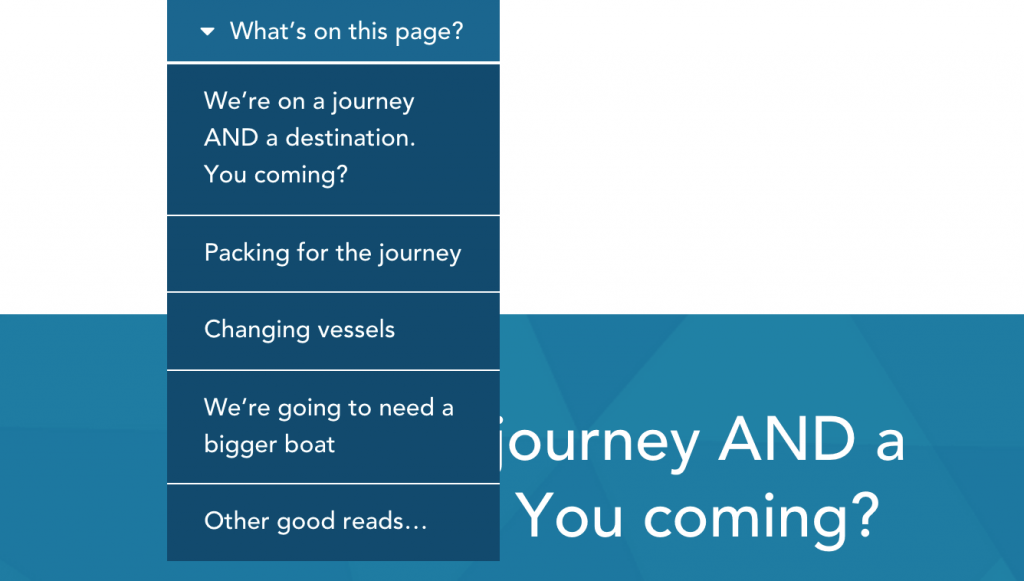
And now, at the start of 2015, we are launching our new site. Just like we often hear people say, "we're all temporarily abled," this site is "temporarily done." That means it is done at this moment in time. We've already got a backlog of things we want to improve. Things we want to research and revisit. For example, we implemented a table of contents in the header of the site. We based this design on work that we started over three years ago. The table of contents performed admirably with an audience of senior citizens in a health insurance scenario. We've experimented with it and improved it over the years, and we felt great about it as an alternative to the age-old "skip to main content" link. It seemed to get closer to the heart of what people actually need to navigate easily on a web page. And then, in our latest round of usability tests for people with disabilities, just this month, it didn't do so well.
Rather than scrap it completely after a less than perfect test, we're going live with it as it is. We're continuing to test, and we're considering other ideas. We want more feedback so we can keep on iterating.
Last year, the big question was: "Where are we going?" This year, in 2015, it is: "Who is coming with us?"
Welcome aboard this journey. Yes, you. Everyone! But, I'm pretty sure we're going to need a bigger boat.
Archived from: Accessibility, the journey AND the destination - WayBack Machine.